

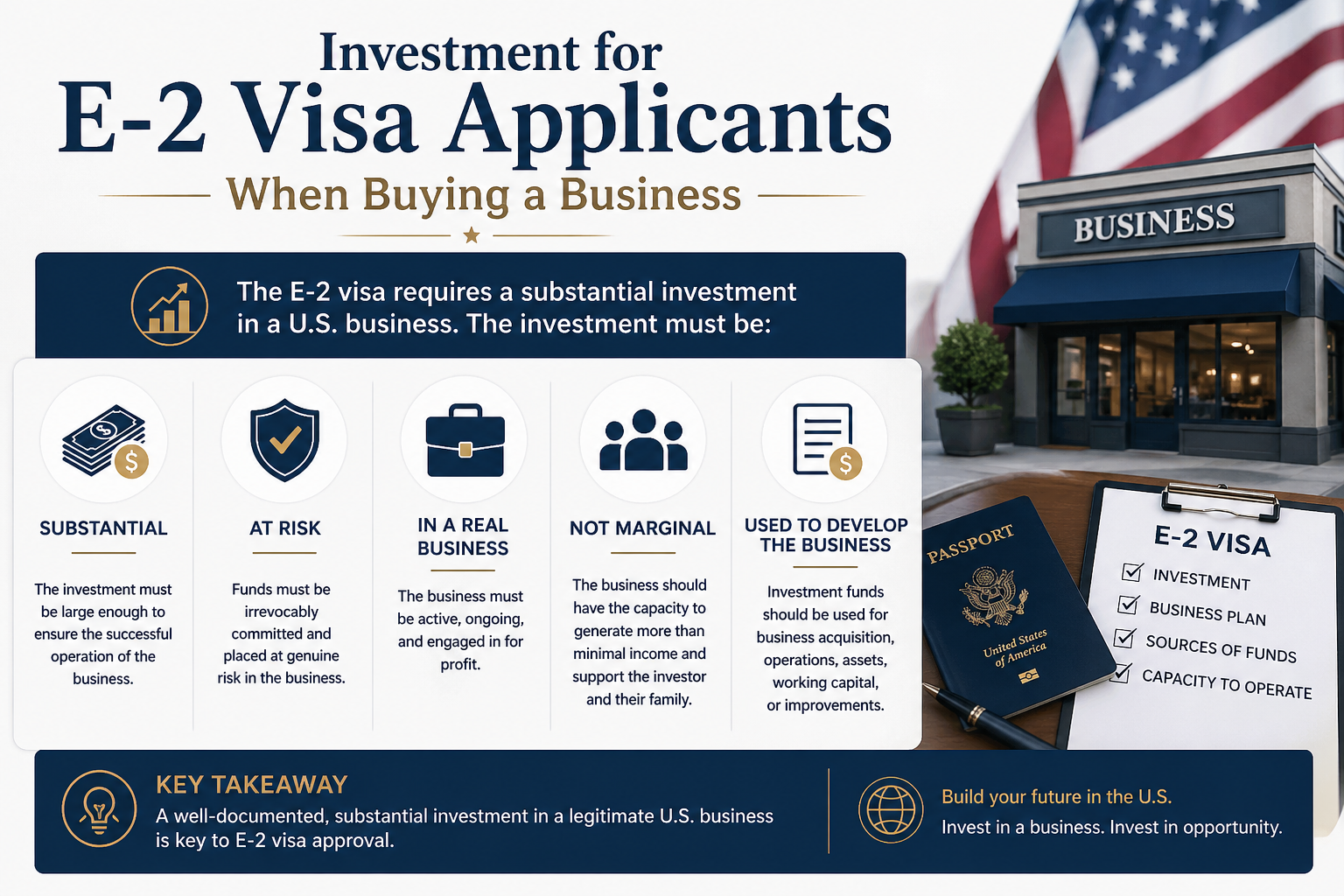
Buying a profitable business does not, on its own, satisfy the E-2 investment test. The transaction is the easy part. What officers actually look for is whether the capital is committed, at risk, deployed into operations, and tied to a business the investor will direct, not just own. The gap between completing the purchase and meeting the immigration standard is where most acquisition-based E-2 cases run into trouble.
This is not a problem of effort. It is a problem of framing. The same factors that make an acquisition look attractive commercially, such as existing revenue, established systems, and in-place management, can make it look passive from an immigration standpoint if the case is not built carefully. Working with an experienced E-2 visa law firm is often the difference between a clean approval and a Request for Evidence that exposes structural gaps in the file.
What “Active Investment” Actually Means
The E-2 standard is not about how much was spent. It is about how the capital is functioning.
Investment under the E-2 framework requires committed funds that are at risk for the purpose of generating income. That phrasing matters. A lump-sum payment to a seller transfers ownership but does not, by itself, demonstrate that the capital is now active inside the enterprise. Officers expect to see how the remaining capital, including working capital, growth funding, and operational reserves, continues to do work in the business after the transaction closes.
The most common version of this mistake is treating the purchase price as the entire investment story. If the structure does not show capital flowing into operations after closing, the file can read as a transfer of ownership rather than an active investment, even when the dollar figure is substantial.
The Trap of Leaning on Historical Performance
Established businesses come with records. That is part of what makes them attractive. It is also where applicants overcommit to the wrong evidence.
E-2 adjudication is forward-looking. The question is whether the enterprise will be active and non-marginal under the new ownership, not whether it was profitable under the seller. Tax returns, P&L statements, and customer rosters from the prior owner are useful context, but they are not the case.
The case has to show the investor’s plan: revised projections, the operational role the investor will take, growth or stabilization initiatives, and credible evidence that the business will continue to generate more than minimal income. A petition that leans on the prior owner’s track record and skips that forward-looking work tends to read as a financial transaction rather than an active commitment, and gets adjudicated accordingly.
Transactions Structured for Business, Not for the Visa
Acquisitions are usually negotiated for commercial reasons: price, liability allocation, tax efficiency. Structures that make sense on those terms can quietly create E-2 problems.
Escrow arrangements are the cleanest example. Holding funds in escrow pending visa approval is standard practice, but escrow terms that are easily reversible, broadly conditional, or weighted toward the buyer can suggest that the capital is not truly committed. The “at risk” requirement does not survive a structure where the investor can recover most of the funds if the visa does not issue.
Installment-based purchases create a similar issue. They are not disqualifying, but they require careful documentation to demonstrate that enough capital is already deployed and at risk at the time of filing. A petition built on the assumption that future installments count as present investment is a weak petition.
Significant seller financing is the third version. If the seller retains practical control over key assets, or if repayment terms reduce the buyer’s actual financial exposure, the investment may not meet the standard, regardless of the headline purchase price.
The structural fix is to align the transaction terms with E-2 requirements before closing. Once the deal is signed, options narrow.
The “At Risk” Standard in Acquisition Cases
Funds are “at risk” when they are subject to partial or total loss if the business does not succeed. This is straightforward in a startup. It gets more complicated in an acquisition.
Capital that sits in non-operational assets, that is held in reserve without a clear operational purpose, or that can be withdrawn without affecting the business may not satisfy the standard, even if it nominally belongs to the enterprise. The same is true for purchase prices allocated heavily to goodwill or to assets that the investor could liquidate without affecting operations.
The documentation has to show that the capital is committed irrevocably to the business. Bank records, transaction documents, and financial agreements need to establish that funds have moved into the enterprise and cannot be quietly pulled back. Ambiguity in the financial trail invites RFEs.
Operational Control and the Passive-Owner Problem
E-2 classification requires that the investor will develop and direct the enterprise. Buying an existing business, especially one with a competent in-place management team, can make that requirement harder to demonstrate, not easier.
Retaining the existing team is often a sound business decision. It also raises the bar on showing that the new owner is doing more than collecting distributions. Officers expect to see meaningful authority, strategic oversight, and active engagement at a level appropriate to the business.
The documentation has to reflect that role: organizational charts that show the investor’s position, employment agreements where relevant, written descriptions of decision-making authority, and concrete evidence of operational involvement. Delegation is fine. Absence is not.
Business Plans That Belong to the Seller
A forward-looking business plan is essential in any E-2 petition. In an acquisition context, it is also a place where applicants quietly cut corners.
Reusing the seller’s plan, or lightly modifying it, almost always weakens the case. The plan submitted with the petition needs to reflect new ownership: the investor’s strategy, capital allocation, growth or stabilization initiatives, hiring plan, and operational approach. It needs to address how the investor intends to grow income, manage costs, and create employment, not just describe a business that already exists.
A plan that reads as if it could have been written by the prior owner does not establish that the applicant will direct and develop the enterprise. It establishes that the applicant has assumed the prior owner’s view of the business, which is not the standard.
How These Cases Fail in Practice
A common pattern: an investor buys a profitable restaurant intending to keep it running as it is. The transaction closes cleanly, revenue holds steady, and the petition is filed. The officer reviewing the file sees a successful acquisition and a passive owner. There are no new initiatives, no documented operational role, no forward-looking plan that distinguishes the new ownership from the old. The case is technically complete and structurally weak.
A second pattern: an investor acquires a service business with personal funds and significant seller financing. The total purchase price is substantial. At the time of filing, only a portion of the funds has actually moved into the business. The remaining balance is contingent on future performance milestones. The “at risk” question becomes whether the deployed capital alone meets the substantial-investment standard for this enterprise. The petition can survive, but only if that question is addressed directly with documentation.
Both cases would have been straightforward if the immigration framing had been built into the transaction at the outset rather than added on at the filing stage.
What a Cleaner Acquisition-Based E-2 Looks Like
The strongest acquisition-based E-2 cases tend to share a few features: capital that visibly continues to work inside the business after closing, a transaction structure that survives the “at risk” test without explanation, an investor whose operational role is documented before the petition is filed, and a forward-looking business plan that belongs to the new owner rather than the old one.
None of this is exotic. It is the predictable result of treating the immigration test as a design constraint on the deal, not a paperwork exercise after it. Buyers who plan that way tend to land cleanly. Buyers who don’t tend to spend the next year answering RFEs.